
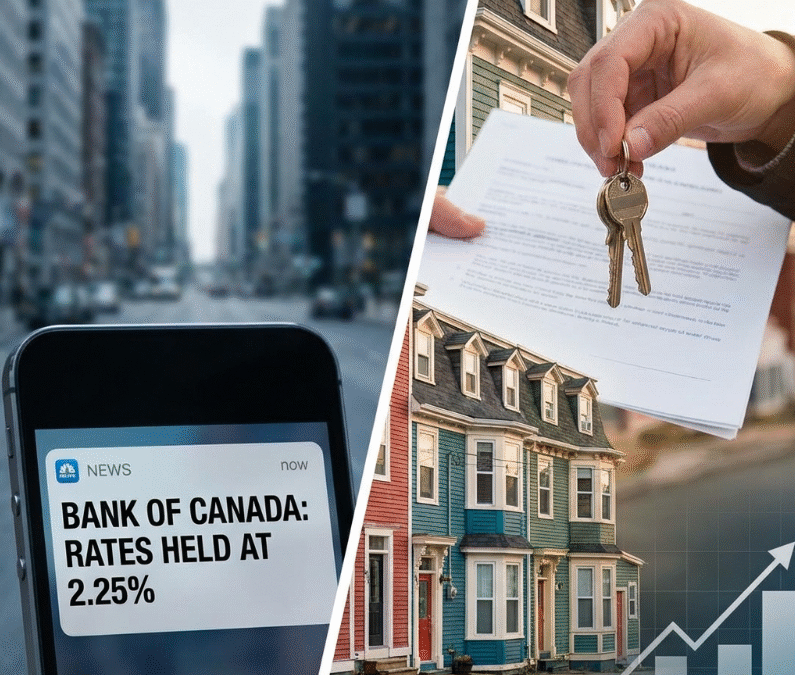
Last week, the Bank of Canada held its overnight rate at 2.25%. The headlines declared stability. Economists lined up to predict more of the same through 2026.
But here’s what those headlines won’t tell you.
While Toronto and Vancouver watch their real estate markets cool off, St. John’s posted 9.6% price growth year-over-year. While national conversations focus on buyer relief, Newfoundland homeowners are sitting on equity they haven’t seen in decades. While economists debate the next move, Atlantic Canadian borrowers face decisions with nothing to do with what happens in Ottawa.
I’ll cut through the economic theory and show you what this rate environment means for your mortgage strategy.
The Consensus Nobody’s Questioning
About 75% of economists polled by Reuters expect the Bank of Canada to hold rates steady through 2026. 26 out of 35 forecasters are betting on no change.
The reasoning sounds solid enough. Inflation is contained. Growth is modest. The current 2.25% rate sits at the low end of the Bank’s neutral range.
But here’s the problem with consensus.
Bank of Canada Governor Tiff Macklem admitted that “the timing or direction of the next change” is difficult to predict given heightened uncertainty. His senior deputy was even more candid: “Just when we think we’ve thought of everything that could possibly hit us, something new happens.”
This isn’t stability. This is a holding pattern in turbulent air.
What “Mixed Signals” Actually Means
The data tells two different stories depending on which numbers you’re watching.
Canada’s job growth stalled in December after three straight months of gains. Inflation rose more than expected in the latest report. But core inflation measures fell. GDP projections show modest growth of 1.1% in 2026, down from earlier forecasts.
The Bank estimates U.S. tariffs will reduce GDP by about 1.2% by the end of 2026 compared to previous projections. Trade tensions create uncertainty. Business confidence has slowed. Investment has cooled.
So what does the Bank do when the economy sends conflicting messages?
They hold steady. They wait. They watch.
This creates both opportunity and risk for borrowers.
The Newfoundland Exception
Here’s what gets lost in national headlines about cooling markets and buyer relief.
Newfoundland’s average home price is roughly half the Canadian average. Rate sensitivity works differently here. A quarter-point move that dramatically impacts a $900,000 Toronto mortgage barely registers on a $450,000 St. John’s property.
But the bigger story is appreciation.
While major metro markets cooled off in 2025, St. John’s prices are forecast to rise 10% going into 2026. Active listings in Newfoundland numbered 2,191 units at the end of November, a 27.2% decline from the previous year and the lowest November inventory in two decades.
This is a seller’s market. It has been for nearly two years. It’s showing no signs of slowing.
This creates accessible equity homeowners haven’t had in years.
The Refinancing Window Nobody Talks About
Canadians now owe $1.75 for every dollar of disposable income. Household debt hit a record 174.9% debt-to-income ratio by Q2 2025. Mortgages account for about 75% of the total.
In Newfoundland, average non-mortgage debt sits at $24,843, the highest in the country.
Here’s why this matters in a stable rate environment.
Strong home appreciation over the past two years means equity is accessible. Rates are sitting in a predictable range. You can lock in for four months before your renewal date, giving you time to evaluate options without pressure.
This is the refinancing opportunity most homeowners miss.
Lower your payment. Extend your timeline. Consolidate high-interest debt into one manageable monthly amount. Reconfigure your finances while rates hold steady instead of waiting for them to move.
Stability creates planning windows. Most people waste them waiting for something better.
Fixed vs. Variable When Nothing’s Moving
Right now, the spread between fixed and variable rates is narrow. That changes the risk-benefit calculation entirely.
If you believe the economy will weaken as 2026 progresses, variable makes sense for two reasons. You get real-time rate decreases if the Bank cuts. You also maintain the ability to convert to fixed at any time without penalty.
But if you think stability holds or conditions tighten, locking in a fixed rate protects you from surprises.
The key is understanding what drives rate movement.
The Bank of Canada and bond markets react primarily to three indicators: monthly unemployment numbers, the Consumer Price Index measuring inflation, and quarterly GDP figures. Those three data points move the five-year Canada bond yield that determines fixed rates and the Bank of Canada prime rate that drives variable mortgages.
Watch those numbers. They’ll tell you more than economist predictions.
The Renewal Trap in Stable Markets
More than 1.2 million Canadians will renew their mortgages in 2025. About 60% of all outstanding mortgages renew by the end of 2026.
Bank of Canada analysis shows mortgage holders with five-year fixed-rate contracts renewing in 2025 or 2026 could face payment increases of 15% to 20%.
Here’s the trap.
Your bank sends a renewal letter. The rate looks reasonable given current conditions. You sign it and move on.
But you never compared it against 20+ other lenders. You never evaluated whether a different term structure made more sense. You renewed out of habit instead of strategy.
I’ve seen clients save thousands by being proactive. Four months before renewal, we lock in rates and compare options across the entire lending market. Sometimes the bank’s offer is competitive. Often it’s not.
Timing matters. Early conversations create options. Late conversations create pressure.
What Atlantic Canada Should Watch Instead
National forecasts miss regional realities.
Ontario’s housing market posted the steepest price drop of any region in Canada last year. Toronto sales hit a 20-year low. Vancouver notched fewer sales than during the 2008 financial crisis.
Meanwhile, less-populated provinces including Newfoundland, Nova Scotia, New Brunswick, and Manitoba all recorded price growth in 2025.
This isn’t a footnote. This is a fundamentally different market.
Newfoundland’s population grew 1.2% last year, the largest spike since the 1990s. Over 9,000 international immigrants arrived in 12 months. Net migration from other provinces added demand pressure.
Those factors matter more to your mortgage decision than what’s happening in the Greater Toronto Area.
Three Moves to Make Now
Start renewal conversations four months early. Lock in your rate. Compare lenders. Evaluate term options. Create space to make decisions without deadline pressure.
Assess your equity position. If your home has grown in value over the past two years, calculate what’s accessible. Determine whether refinancing makes sense for debt consolidation or financial restructuring.
Match your mortgage to your economic outlook. If you believe conditions will weaken, variable gives you flexibility and real-time benefit from rate cuts. If you think stability holds or uncertainty increases, fixed protects you from surprises.
But don’t follow your friend’s strategy from 2024. Don’t assume what worked before works now. Different people have different risk tolerances and different financial situations.
Absorb information. Get multiple opinions. Make the decision that fits your particular situation at this point in time.
The Misconception That Costs Money
I regularly correct one fundamental misunderstanding about how interest rates work.
People think bad economies create higher rates and good economies create lower rates.
The opposite is true.
When the economy weakens, rates decrease to stimulate growth. When the economy overheats, rates increase to cool it down. Rates are a tool, not a consequence.
This is why there are no surprises when the Bank moves. Rate increases and decreases are always justified by economic indicators. The economy is cyclical. Rates are cyclical.
Understanding the relationship changes how you evaluate economist predictions and Bank of Canada announcements.
What Stability Actually Offers
The Bank of Canada’s rate hold through 2026 isn’t a guarantee. It’s a forecast based on current conditions and assumptions about tariffs, trade, inflation, and growth.
But stability, even temporary stability, creates planning windows.
You can evaluate refinancing without worrying about rate spikes. You can lock in renewal rates months in advance. You can make strategic decisions instead of reactive ones.
The opportunity isn’t in predicting what the Bank will do next. The opportunity is using the current environment to optimize your mortgage strategy while conditions hold.
Most people wait for perfect information. By the time they get it, the window has closed.
—
Rob Jennings is a mortgage broker with Jennings & Associates – East Coast Mortgage Brokers in St. John’s, Newfoundland. He’s ranked among Canada’s top mortgage professionals and has helped over 4000 Atlantic Canadian families navigate mortgage decisions across multiple rate cycles.
If you’re coming up for renewal in the next 12 months or considering refinancing, start the conversation now. Call Rob at 709-300-4518 or email hello@jenningsmortgage.com to explore your options while rates hold steady.